Holes · Cracks · Water damage · Tape
Drywall repair in Ottawa that you cannot find afterwards.
A hole from a doorknob, a crack that returns every winter, a stain where the roof leaked. We rebuild the board, tape and feather the joint wide, prime it and paint it, so the wall reads as one surface again.
12 years of experience. Free estimate on every job. One crew for the repairs and the paint.
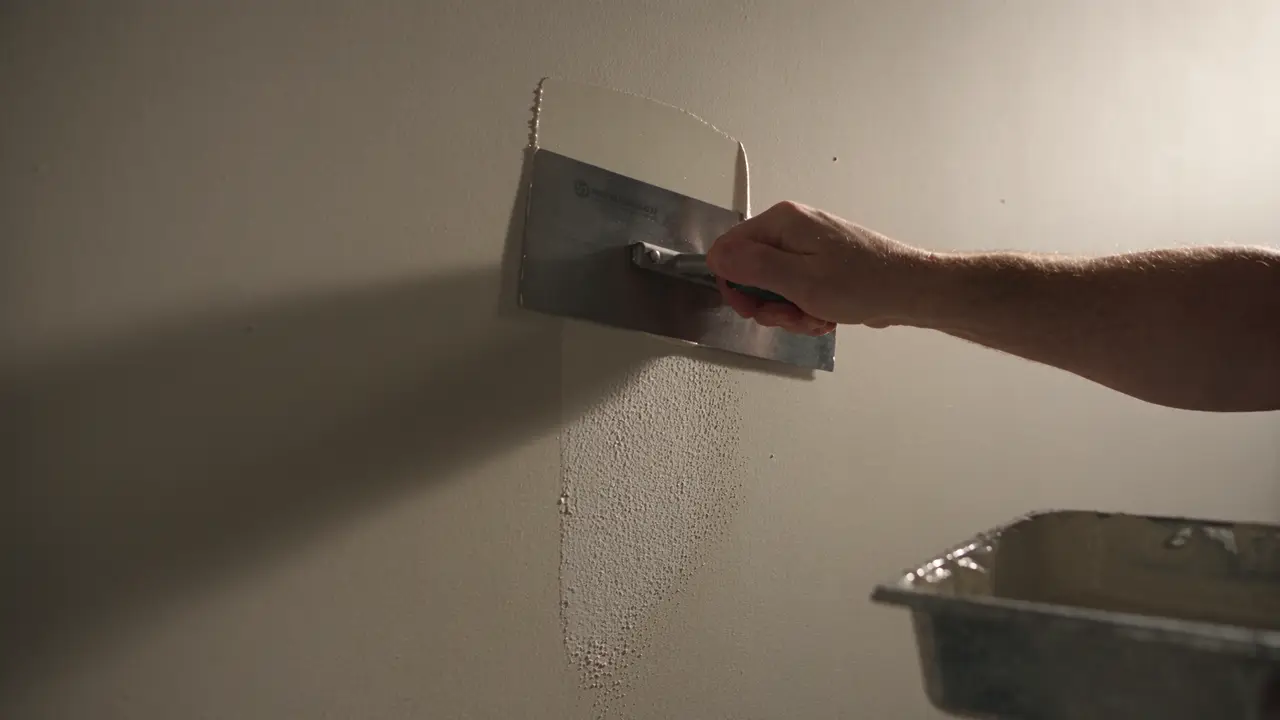
- What we fix
- Holes, cracks, nail pops, tape, corners, water damage
- Includes
- Priming and painting the repair to match
- Older homes
- Compound from before 1990 is tested before sanding
- Next step
- Send a photo or call for a look
Why drywall patches show, and how to stop it
Ottawa drywall repair has its own habits, because the houses here move with the seasons. Almost anyone can fill a hole in a wall. Making the repair vanish is a different skill, and it comes down to four things.
A patch that is flat, not proud
The most common failed repair is a hump: too much compound, piled over the damage and sanded into a mound. It looks fine head-on and jumps out the moment light comes across the wall from a window or a lamp. A proper drywall repair uses thin coats, each one wider than the last, so the patch tapers to nothing over a wide area. A hole the size of a fist can need a feathered area the size of a serving tray.
Tape at every joint
Wherever two pieces of drywall meet, or a crack has opened along a seam, compound alone will crack again. The joint needs tape bedded in compound to bridge it. Paper tape is strongest for flat seams and inside corners. Fibreglass mesh has its uses with setting-type compound on small patches. Choosing the wrong pairing is one of the main reasons repairs re-crack.
Matching the texture
A perfectly smooth patch on a wall with roller stipple from five previous paint jobs still shows, as a slick spot. We prime the repaired area, then roll it with a nap that rebuilds the same light texture. The surface then matches before the finish coat. Ceilings with a knockdown or stipple texture need the pattern recreated by hand, which is a craft of its own.
Primer, then paint to a break
Fresh compound is thirsty and absorbs paint differently from the painted wall around it. Without primer the patch flashes: it shows as a dull shape in the sheen even when the colour matches. After priming, painting only the patch rarely works on older walls, because paint fades and changes over the years. The reliable method is to paint the whole wall, corner to corner, so the eye has no edge to find.
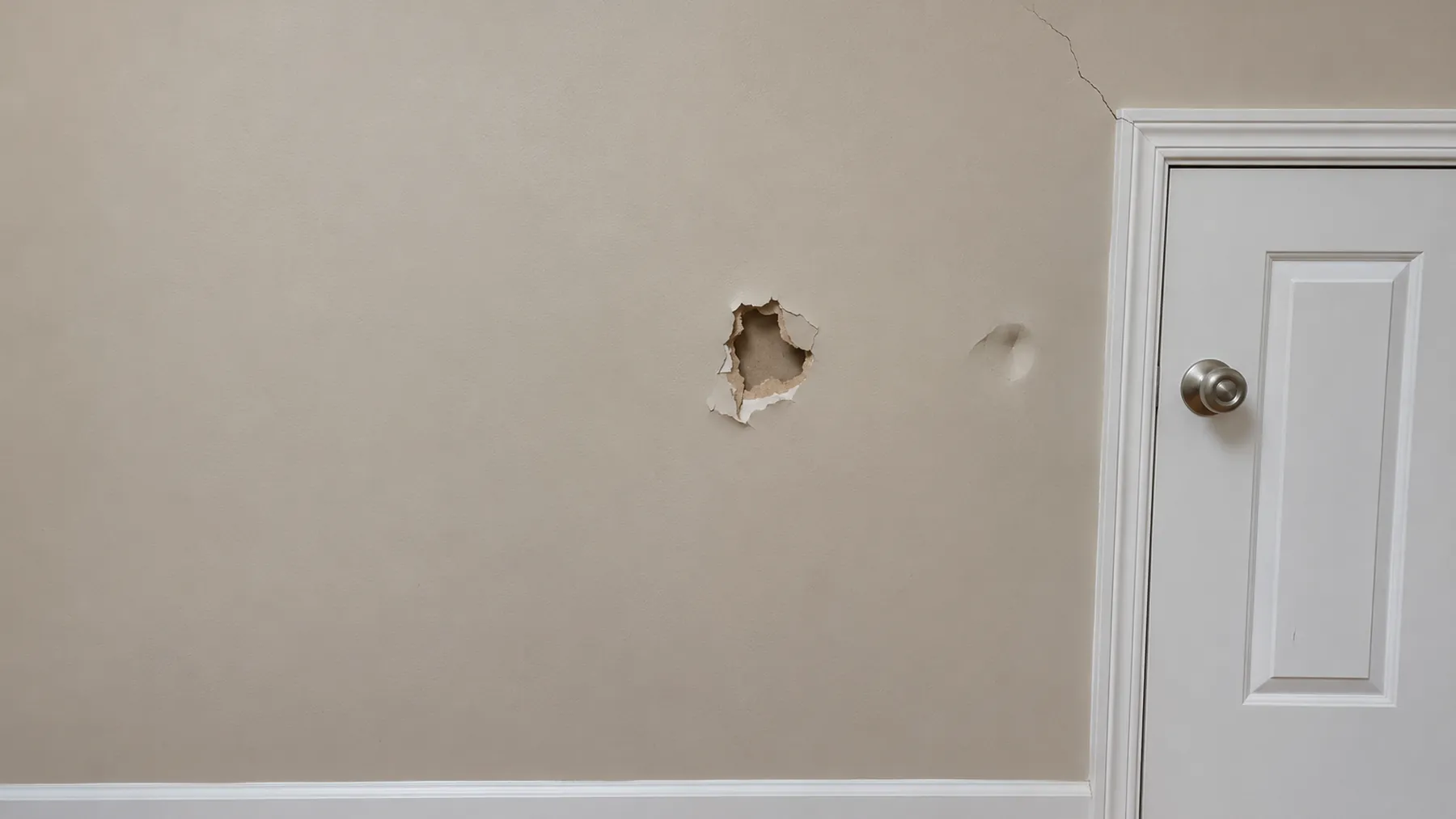
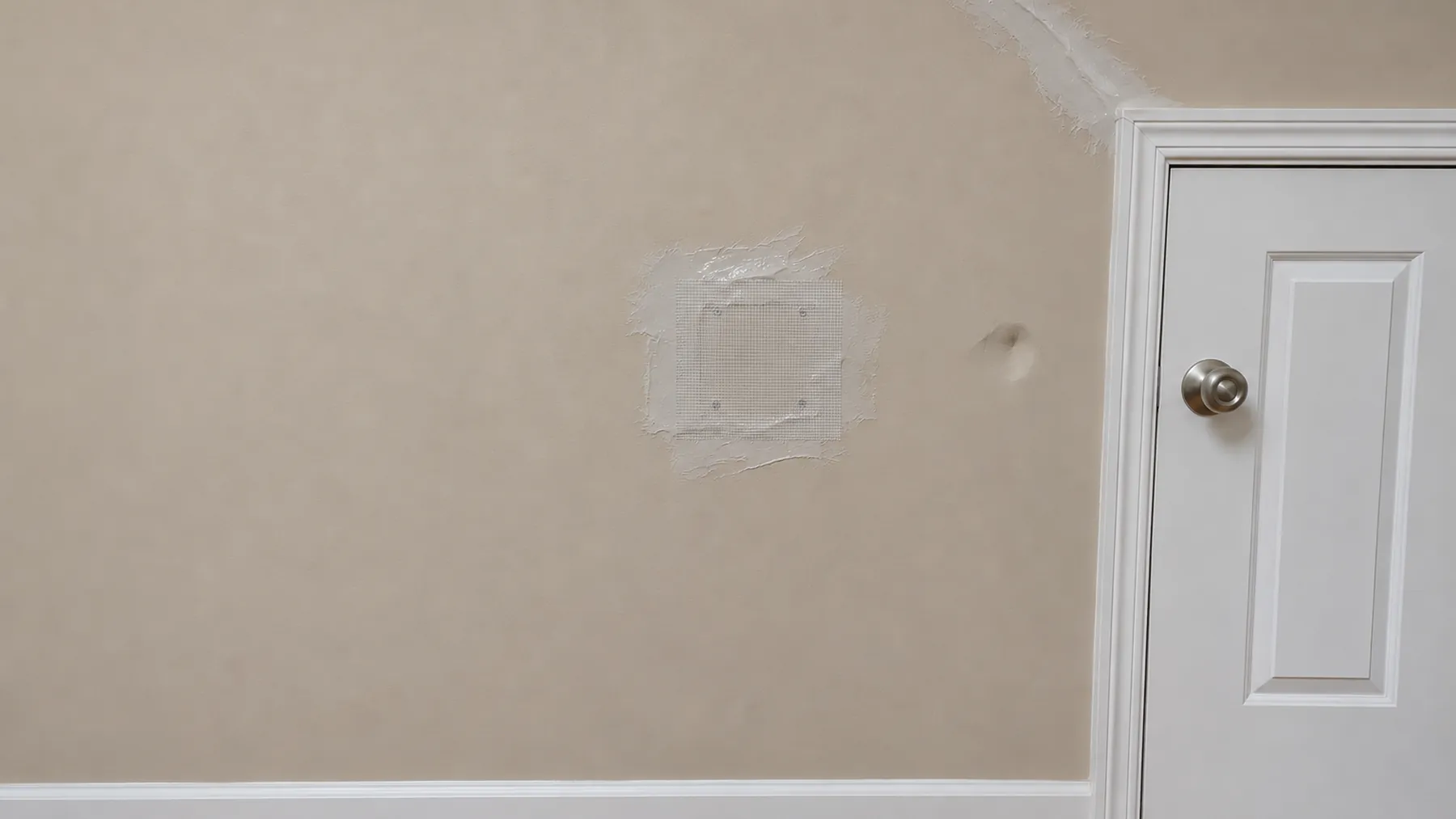
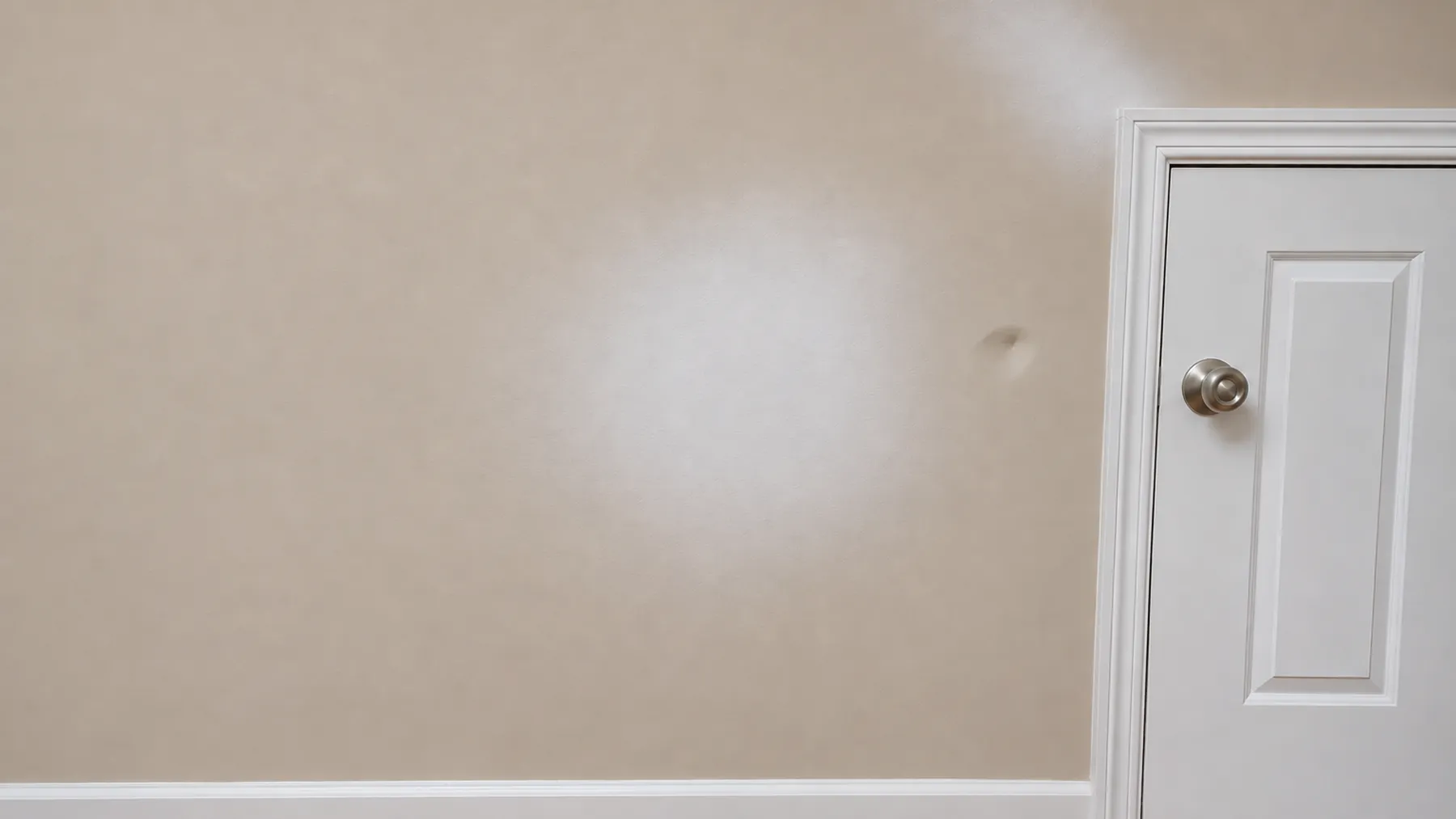
A wall, start to finish
From hole to nothing to find.
Three kinds of damage
A hole, a dent and a crack each need a different repair. Filler alone only suits one of them.
Patch and tape
New board goes into the hole and tape bridges every edge, including the crack, so the repair cannot open again.
Skim wide, then prime
Compound is feathered far past the patch and sanded flat. Primer seals it so the repair does not flash through the paint.
Paint the whole wall
Touching up a patch leaves a halo. The wall is painted corner to corner so the repair cannot be found.
Photo-realistic renders.
Common damage, and the right repair
The method depends on the size and the cause. These are the drywall repair jobs we see most in Ottawa homes.
| Damage | Usual cause | How it is repaired |
|---|---|---|
| Nail and screw pops | Framing lumber drying and shrinking in a new home; seasonal movement | We reset or remove the loose fastener and drive a new screw into the stud beside it. We then fill the spot in two or three thin coats. |
| Small holes and dents | Picture hooks, anchors, furniture, door handles | Filled with a lightweight filler or setting compound, sanded flush and spot-primed. A doorknob hole gets a backed patch and a door stop. |
| Medium holes | Plumbing or electrical access, an accident | Cut back to a clean square, a new piece of drywall fixed to backing strips or studs, joints taped and finished in three coats. |
| Cracks at seams and corners | House settling, seasonal humidity swings, truss movement | Loose tape and compound removed, the joint re-taped and finished. Where movement returns each year, a flexible detail is used at the corner. |
| Peeling or bubbled tape | Not enough compound under the tape when the house was built, or moisture | The failed section is cut out, new tape bedded properly and the joint refinished wide. |
| Crushed outside corners | Furniture, vacuums, moving day | Damaged corner bead is straightened or replaced and the corner rebuilt with compound. |
| Water damage | Roof leak, ice dam, plumbing leak, bathroom overflow | The source is fixed first. Soft, sagging or mouldy board is cut out and replaced; sound but stained board is sealed with a stain-blocking primer. |
Larger jobs, such as boarding a whole basement, are a different trade scope that full-time drywall contractors usually handle. Ask and we will tell you plainly whether it is work we take on.
What does your wall look like?
Choose the closest match to see the likely cause and what the repair involves.
How a repair is done properly
A medium patch usually takes two visits. The compound needs time to dry between coats. Here is the sequence for a typical drywall repair.
Protect and contain
We cover floors and furniture. Sanding dust travels, so we close off the work area where practical and sand with dust-collecting tools where possible.
Cut back to sound material
We remove loose paper, crumbled gypsum and failed tape. We cut a ragged hole to a clean rectangle so a new piece fits tightly.
Back it and board it
Wood or metal backing is fixed behind the opening and a new piece of drywall of the same thickness is screwed to it. Ceilings and fire-rated walls get the matching board type.
Tape and first coat
Joints are taped and bedded. A setting-type compound, which hardens chemically, is often used first because it shrinks less and allows a second coat the same day.
Second and third coats
Each coat is spread thinner and wider than the last, feathering the edges out onto the existing wall until a straightedge shows no hump.
Sand, prime, texture
A light sand under a raking light, then primer over all new compound. Roller texture or ceiling pattern is matched at this stage.
Paint
We paint the repair to the nearest natural break: usually the whole wall or the whole ceiling, so the result is one even surface.
Wall problem matcher
Which one looks like your wall?
Tap the photo closest to your wall or ceiling to see the likely cause and what happens before it is painted.
Pick a photo to see the likely cause and what to do.
Likely
Nail pops
- Likely cause
- Framing lumber drying and moving in the first years, pushing fasteners out through the filler.
- What it means
- Common and harmless, mostly in newer homes.
- What to do
- Reset the fastener, add a screw beside it, then fill and sand.
- Before painting
- Fill, spot-prime, then paint the whole wall.
Likely
Stress crack
- Likely cause
- Seasonal movement gathering at the weakest point of the wall, the corner of an opening.
- What it means
- Usually cosmetic. A crack that keeps growing, or a door that starts to stick, deserves a closer look.
- What to do
- Tape the crack and skim it wide; filler alone opens again.
- Before painting
- Taped, skimmed, primed and repainted.
Likely
Moisture peeling
- Likely cause
- Steam getting behind a paint film, often where there is no fan or the wrong paint was used.
- What it means
- The paint has lost its bond; more will follow.
- What to do
- Scrape to a sound edge, treat any mildew, seal and repaint.
- Before painting
- A moisture-resistant finish, and a fan that is used.
Likely
Failed joint tape
- Likely cause
- Tape that was bedded in too little compound, or a joint that got damp.
- What it means
- The tape has let go and will keep lifting.
- What to do
- Cut out the loose tape, re-tape and skim the joint.
- Before painting
- Skimmed flat, primed, then painted.
Likely
Water stain
- Likely cause
- Water coming through from a roof, a window, a pipe or condensation.
- What it means
- The stain is the mark; the leak is the problem.
- What to do
- Find and fix the source before any repair.
- Before painting
- A stain-blocking primer, or the mark bleeds back through.
Likely
Flashing and lap marks
- Likely cause
- Touch-ups over unprimed patches, or paint rolled over an edge that had already started to dry.
- What it means
- A finish problem, not a wall problem.
- What to do
- Prime the patches and repaint the wall in one go.
- Before painting
- Two full coats, keeping a wet edge.
Photo-realistic examples. Several problems can look alike; a look at the wall settles it.
Drywall problems Ottawa houses get
Ottawa swings from humid summers to dry, heated winters, and wood-framed houses move with it. Lumber swells and shrinks, and drywall, which is rigid, shows the strain at its weakest points: seams, corners and fasteners. So cracks often appear in January and February. Some close up again by July.
Much of the city also sits on clay. Clay soils shrink in dry spells and swell when wet, and houses on them can shift slightly over the years. Small recurring cracks above doors and at the corners of windows are a typical sign. They are usually cosmetic, but a crack that keeps widening should be assessed before it is repaired.
Winter brings ice dams, where melting snow refreezes at the eaves and water backs up under the shingles. The first sign indoors is often a stain or a sagging patch on an upstairs ceiling near an outside wall. The roof or attic issue must be solved before we fix the ceiling, or the stain comes back.
Homes built before 1990 raise one more point. Old joint compound and ceiling texture can have asbestos in them. Builders often used asbestos before 1990. That comes from Health Canada. We sample old compound and send it to a lab before anyone cuts or sands it. Ontario has its own rules for that, too.
Where the damage is changes the repair
The same hole is a different job in a bathroom, a garage or a stairwell.
Finish levels, and why smooth costs effort
What a "level 5" finish means
The drywall trade grades finishes from level 0 to level 5. Most house walls are finished to level 4: tape, three coats on joints and fasteners, sanded smooth. Level 5 adds a thin skim coat over the entire surface, so paper and compound present one uniform face to the paint. It matters most under glossy paint, dark colours and strong side light, where a level 4 wall can show faint stripes at every joint.
Skim coating tired walls
Some walls have been patched many times, stripped of wallpaper, or damaged when tiles or panelling came off. A full skim coat can bring them back: two thin layers of compound trowelled over the whole wall and sanded. A skim coat is the closest thing to a new wall without replacing the board. Often it is the right preparation before a premium paint finish.
Repair and paint by one crew
Drywall repair and painting are often split between two trades, and the handover is where things go wrong. Patches are left unprimed, texture does not match, and a painter gets blamed for a hump he did not make. We do both, so the person finishing the patch is the person who must make it disappear under paint. When the repair is part of a larger repaint, it becomes part of the prep for interior painting in Ottawa.
Questions people ask
Good to know first.
Can you repair a single patch, or do you only take large jobs?
A small drywall repair is welcome. Tell us the size and send a photo if you can. One patch usually means two short visits, because the compound needs to dry between coats.
Will the repair be visible after painting?
A drywall repair done properly does not show. We feather the patch wide, prime it, texture it to match and paint the whole wall. If we paint only the patch on an older wall, a slight difference in colour or sheen is likely. That is why we recommend painting to the corners.
Why do my cracks keep coming back?
Because the house is still moving at that spot and the last repair was rigid. Filling a moving crack with compound alone lasts one season. Re-taping, and in some locations a flexible detail, is what holds.
Do you fix water-damaged drywall?
Yes, once the leak is fixed. We seal stained but solid board with a stain-blocking primer and repaint it. We cut out and replace board that is soft, swollen, sagging or mouldy. For ceilings, see our page on ceiling repair in Ottawa.
Is there asbestos in my drywall?
The board itself is rarely the issue. Joint compound and ceiling texture used before about 1990 can contain it. In a home of that age, material that must be cut or sanded is tested by a lab first. A test is inexpensive and takes a few days.
How long does a drywall repair take?
Small fills can be done in a day with fast-setting compound. A proper patch with taped joints is normally spread over two or three days, mostly drying time, with the painting on the last visit.
Can you match a textured ceiling?
Light stipple and knockdown patterns can usually be matched closely by hand. Heavy sprayed texture is harder to blend invisibly, and in older homes it must be tested before it is disturbed. Sometimes the better answer is to take the whole ceiling smooth: see popcorn ceiling removal in Ottawa.
Do you paint the wall after the repair?
Yes. Priming and painting are part of every drywall repair, because an unpainted patch is only half fixed. If you have the original paint, we use it; if not, we match the colour and paint the full wall.
More from The Ottawa Painter
See a room get prepped and painted step by step, and try the colour tools, on the main page for painters in Ottawa. Or go straight to another service or area.
Start with a conversation
Tell us about the job
613-851-7831The estimate is free. Call for the quickest answer, or send the form and you will get a call back to talk through the rooms, the surfaces and the timing.